
Type Order | Motto Benemerentium Praemium Status Currently awarded | |
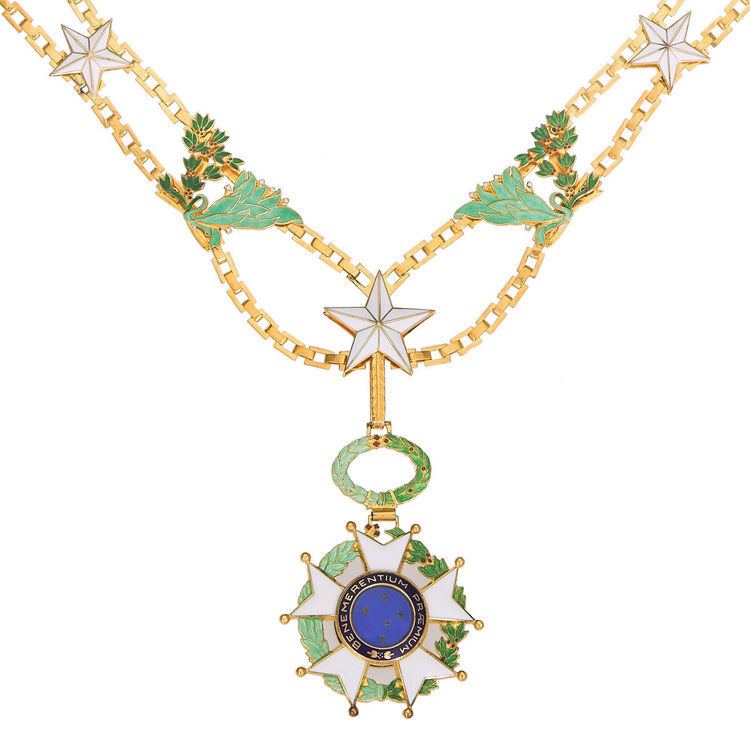 | ||
Awarded for "As a token of gratitude and recognition for those who have rendered significant service to the Brazilian nation." Grand Master His Excellency the President of Brazil | ||
The National Order of the Southern Cross (Portuguese: Ordem Nacional do Cruzeiro do Sul) is a Brazilian order of chivalry founded by Emperor Pedro I on 1 December 1822. This order was intended to commemorate the independence of Brazil and the coronation of Pedro I. The name derives from the geographical position of the country, under the constellation of the Southern Cross and also in memory of the name – Terra de Santa Cruz (Land of the Holy Cross) – given to Brazil at the time of European discovery.
Contents
History
Originally known as the Imperial Order of the Southern Cross (Ordem Imperial do Cruzeiro do Sul), the Order was created by Emperor Pedro I on the day of his Coronation, 1 December 1822. Also on the same date the first knights of the order were appointed, to commemorate the crowning of the Empire's first monarch. After the proclamation of the independence of Brazil on 7 September 1822 other honorific awards had been made, but of the Orders of chivalry shared with Portugal, Brazilian branches of which had been created upon independence; the Order of the Southern Cross, created to mark the Coronation of the Empire's founder, was thus also the first purely Brazilian Order.
After the fall of the monarchy, Brazil's first republican Constitution, enacted on 24 February 1891, abolished all titles of nobility and all Imperial Orders and decorations. The Order was later re-established by the government of Getúlio Vargas on December 5, 1932, as the National Order of the Southern Cross.
During the Old Republic period (from the Proclamation of the Republic until the Revolution of 1930), National Orders did not exist and the Brazilian State bestowed only military medals. Restored in 1932, the Order of the Southern Cross was the first Order to be created in the re-established, republican honours system. It is considered the senior Brazilian National Order.
During the Imperial period, the Order of the Southern Cross was not the highest ranking of the Imperial Orders, as it ranked below the Brazilian branches of the ancient orders of chivalry, that originated with Portugal: the Order of Christ (the senior-most Order), the Order of Saint Benedict of Aviz and the Order of St. James of the Sword. Those Orders were shared by Brazil and Portugal; the Order of Christ was shared with the Holy See similar to the Austrian and a Spanish Orders of the Golden Fleece. However among the Brazilian created Orders, the Imperial Order of the Southern Cross ranked first, having higher status than the Imperial Order of Pedro I and the Imperial Order of the Rose.
The Imperial Order of the Southern Cross continues to be used by both branches of the Brazilian Imperial Family as a House Order, awarded by the rival claimants to the position of Head of the Imperial Family, but such awards are not recognized by the Republic of Brazil.
Just like the Emperors of Brazil were ex officio Grand Masters of the Imperial Order, Presidents of Brazil are ex officio Grand Masters of the successor National Order. Accordingly, President Michel Temer is the Order's current Grand Master.
Criteria
Unlike the Imperial Order, that was awarded to Brazilians and foreigners alike, the republican National Order is awarded to foreigners only. When the Order was re-established in by presidential decree on January 13, 1932, it was restricted to foreigners only with the stipulation that all awards of the Order constitute an act of foreign relations on the part of the Brazilian Government.
Brazilians were excluded deliberately. In the Old Republic, the State regarded Orders and decorations as contrary to the principles of republicanism, and thus maintained no honours system; the creation of an Order that would admit Brazilians to its ranks was a step too far. However, the Brazilian State also resented the lack of a decoration with which to honour foreign dignitaries, as is sometimes almost required by diplomatic protocol. For instance, during the celebrations of the Centennial of Brazilian Independence in 1922, several foreign dignitaries, including the King and Queen of the Belgians, came to Brazil for the celebrations. The King of the Belgians bestowed Belgian honours to some Brazilians. Brazilian nationals needed authorization from the Government to accept foreign titles of honour, or else face loss of citizenship, and under normal circumnstances permission for the acceptance of appointment to Orders of Chivalry would not have been granted. While the government of Brazil relaxed its practice and authorized both accepting induction into foreign Orders and the wearing of foreign insignia, it lacked any decorations with which to reciprocate the Belgian gesture. The National Order of the Southern Cross was intended as an Order that would fill that gap. Today, accepting foreign honours and insignia is allowed, and several Orders have been established to which Brazilians may be admitted, starting with the National Order of Merit (Ordem Nacional do Mérito), created in 1946. Even so, the governing statutes of the National Order of the Southern Cross have never been reformed, and it thus remains unavailable to Brazilians. Paradoxically, therefore, the Order's Grand Master — the sitting President of the Republic — is never a member of the Order he or she oversees, and the President's connection with the Order is severed once the President leaves office.
The Decree that re-created the Order (Decree 22.165, signed by Vargas on 5 December 1932) does not mention the creation of a new Order, but the reestablishment of the old Order of the Southern Cross, that had been "created upon the advent of the political independence of Brazil". This was done to improve the prestige of the Order by linking it with the past, that is, by associating it with an Order that had been created more than one century earlier.
In 1932, the republican version of the Order had the same five grades as the old imperial version. In 1939, by a statute issued on 17 July of that year, the additional grade of the Grand Collar was created. Until the creation of the Grand Collar, awards of which are restricted to Heads of State, the Grand Cross was the Order's highest rank.
Awards of, and promotions in, the National Order of the Southern Cross are made by decree of the President of the Republic, in his capacity as the Order's Grand Master. The decree of appointment or promotion is, like all presidential decrees, published in the Federal Government's Official Journal, and, as per the Order's regulations, the appointment or promotion is also recorded in a book kept by the Order's secretary.
The Brazilian Minister of Foreign Relations serves as the Chancellor of the Order, and an officer of the Ministry of Foreign Relations that heads the ceremonial and protocol division serves as the Secretary to the Order. The Order also has a Council, chaired by its Chancellor, that recommends awards and promotions.
Classes
Under its current regulations, the Order consists of the Grand Master and six Classes of members:
Notable recipients
among others