
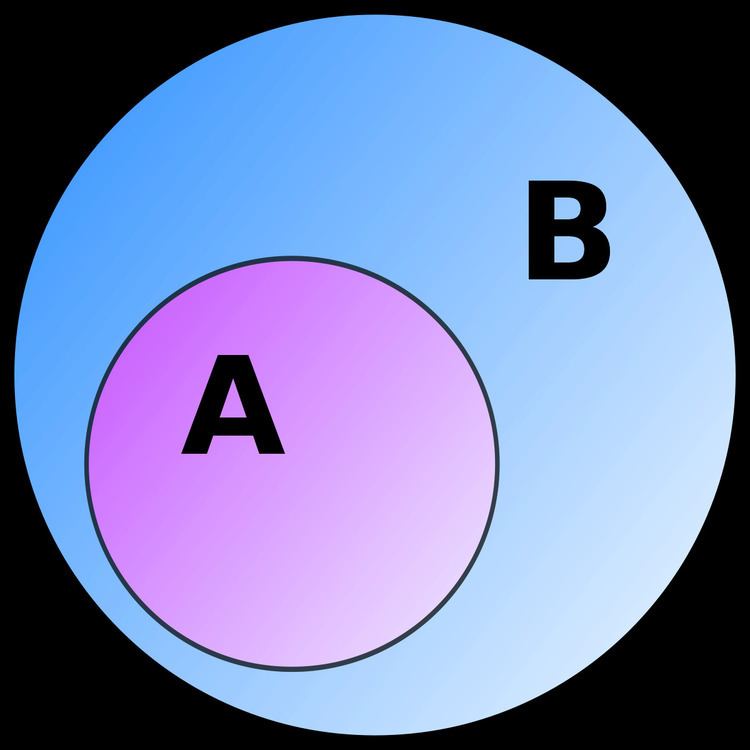
 | ||
In mathematics, if
A "hooked arrow"
This and other analogous injective functions from substructures are sometimes called natural injections.
Given any morphism f between objects X and Y, if there is an inclusion map into the domain
Applications of inclusion maps
Inclusion maps tend to be homomorphisms of algebraic structures; thus, such inclusion maps are embeddings. More precisely, given a sub-structure closed under some operations, the inclusion map will be an embedding for tautological reasons. For example, for a binary operation
is simply to say that
Inclusion maps are seen in algebraic topology where if A is a strong deformation retract of X, the inclusion map yields an isomorphism between all homotopy groups (i.e. is a homotopy equivalence).
Inclusion maps in geometry come in different kinds: for example embeddings of submanifolds. Contravariant objects such as differential forms restrict to submanifolds, giving a mapping in the other direction. Another example, more sophisticated, is that of affine schemes, for which the inclusions
and
may be different morphisms, where R is a commutative ring and I an ideal.