
transliteration ka translit. with handakuten (nga) katakana origin 加 | translit. with dakuten ga hiragana origin 加 spelling kana 為替のカ(Kawase no "ka") | |
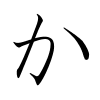 | ||
か, in hiragana, or カ in katakana, is one of the Japanese kana, which each represent one mora. Both represent [ka]. The shapes of these kana both originate from 加.
Contents
The character can be combined with a dakuten, to form が in hiragana, ガ in katakana, and ga in Hepburn romanization. The phonetic value of the modified character is [ɡa] in initial positions, and varying between [ŋa] and [ɣa] in the middle of words.
A handakuten (゜) does not occur with ka in normal Japanese text, but it may be used by linguists to indicate a nasal pronunciation [ŋa].
か is the most commonly used interrogatory particle. It is also sometimes used to delimit choices.
が is used to denote the focus of attention in a sentence, especially to the grammatical subject.
[Supplementary explanation] Historical usage in Yōon くゎ Current usage in か .
Stroke order
The Hiragana か is made with three strokes:
- A horizontal line which turns and ends in a hook facing left.
- A curved vertical line that cuts through the first line.
- A small curved line on the right.
The Katakana カ is made with two strokes:
- A horizontal line which turns and ends in a hook facing left.
- A curved vertical line that cuts through the first line.
Other communicative representations
The Wabun code for か or カ is ・-・・, が or ガ is ・-・・ ・・.