
 | ||
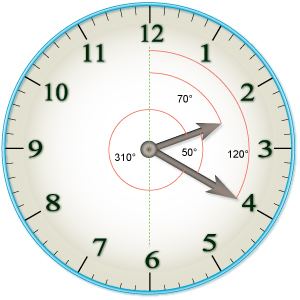
Clock angle problems are a type of mathematical problem which involve finding the angles between the hands of an analog clock.
Contents
Math problem
Clock angle problems relate two different measurements: angles and time. The angle is typically measured in degrees from the mark of number 12 clockwise. The time is usually based on 12-hour clock.
A method to solve such problems is to consider the rate of change of the angle in degrees per minute. The hour hand of a normal 12-hour analogue clock turns 360° in 12 hours (720 minutes) or 0.5° per minute. The minute hand rotates through 360° in 60 minutes or 6° per minute.
Equation for the angle of the hour hand
where:
Equation for the angle of the minute hand
where:
Example
The time is 5:24. The angle in degrees of the hour hand is:
The angle in degrees of the minute hand is:
Equation for the angle between the hands
The angle between the hands can be found using the following formula:
where
If the angle is greater than 180 degrees then subtract it from 360 degrees.
Example 1
The time is 2:20.
Example 2
The time is 10:16.
When are the hour and minute hands of a clock superimposed?
The hour and minute hands are superimposed only when their angle is the same.
H is an integer in the range 0–11. This gives times of: 0:00, 1:05.45, 2:10.90, 3:16.36, 4:21.81, 5:27.27. 6:32.72, 7:38.18, 8:43.63, 9:49.09, 10:54.54, and 12:00. (0.45 minutes are exactly 27.27 seconds.)