Harman Patil (Editor)

Zhao Youqin's π algorithm

Updated on
Edit
Like
Comment
Share on FacebookTweet on TwitterShare on LinkedInShare on Reddit
Zhao Youqin's π algorithm

Zhao Youqin's π algorithm was an algorithm by Yuan dynasty astronomer-mathematician Zhao Youqin (赵友钦, ? – 1330) to calculate the value of π in his book Ge Xiang Xin Shu (革象新书).

Algorithm

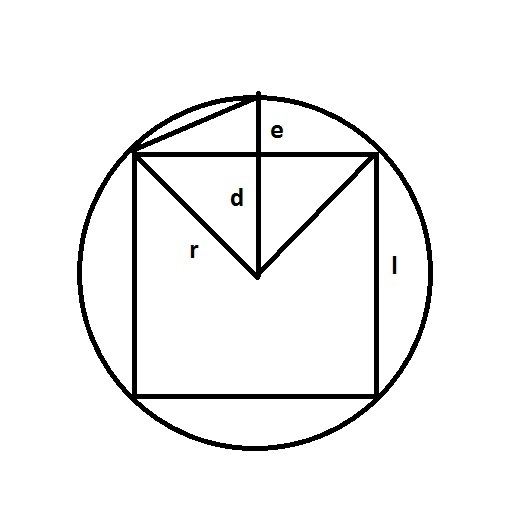
Zhao Youqin started with an inscribed square in a circle with radius r.

If ℓ denotes the length of a side of the square, draw a perpendicular line d from the center of the circle to side l. Let e denotes r − d. Then from the diagram:

d = r 2 − ( ℓ 2 ) 2 e = r − d = r − r 2 − ( ℓ 2 ) 2 .

Extend the perpendicular line d to dissect the circle into an octagon; ℓ 2 denotes the length of one side of octagon.

ℓ 2 = ( ℓ 2 ) 2 + e 2 ℓ 2 = 1 2 ℓ 2 + 4 ( r − 1 2 4 r 2 − ℓ 2 ) 2

Let l 3 denotes the length of a side of hexadecagon

ℓ 3 = 1 2 ℓ 2 2 + 4 ( r − 1 2 4 r 2 − ℓ 2 2 ) 2

similarly

ℓ n + 1 = 1 2 ℓ n 2 + 4 ( r − 1 2 4 r 2 − ℓ n 2 ) 2

Proceeding in this way, he at last calculated the side of a 16384-gon, multiplying it by 16384 to obtain 3141.592 for a circle with diameter = 1000 units, or

π = 3.141592.

He multiplied this number by 113 and obtained 355. From this he deduced that of the traditional values of π, that is 3, 3.14, 22/7 and 355/113, the last is the most exact.

References

Zhao Youqin's π algorithm Wikipedia


Similar Topics
×