.jpg)
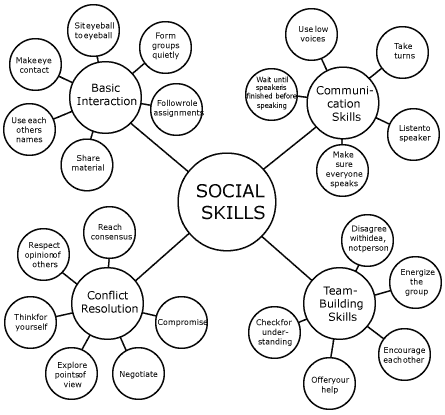
Communication Skills
Communication (from Latin comm?nic?re, meaning "to share") is the activity of conveying information through the exchange of thoughts, messages, or information, as by speech, visuals, signals, written, or behaviour. It is the meaningful exchange of information between two or more living creatures.

One definition of communication is “any act by which one person gives to or receives from another person information about that persons needs, desires, perceptions, knowledge, or affective states. Communication may be intentional or unintentional, may involve conventional or unconventional signals, may take linguistic or non-linguistic forms, and may occur through spoken or other modes.”

Communication requires a sender, a message, and a recipient, although the receiver does not have to be present or aware of the senders intent to communicate at the time of communication; thus communication can occur across vast distances in time and space. Communication requires that the communicating parties share an area of communicative commonality. The communication process is complete once the receiver understands the senders message.[citation needed]
Communicating with others involves three primary steps:
Thought: First, information exists in the mind of the sender. This can be a concept, idea, information, or feeling.
Encoding: Next, a message is sent to a receiver in words or other symbols.
Decoding: Lastly, the receiver translates the words or symbols into a concept or information that a person can understand.
There are a variety of verbal and non-verbal forms of communication. These include body language, eye contact, sign language, haptic communication, and chronemics. Other examples are media content such as pictures, graphics, sound, and writing. The Convention on the Rights of Persons with Disabilities also defines the communication to include the display of text, Braille, tactile communication, large print, accessible multimedia, as well as written and plain language, human-reader, augmentative and alternative modes, means and formats of communication, including accessible information and communication technology. Feedback is a critical component of effective communication.
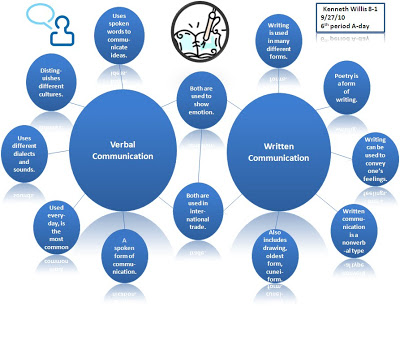
Verbal communication
Human spoken and pictorial languages can be described as a system of symbols (sometimes known as lexemes) and the grammars (rules) by which the symbols are manipulated. The word "language" also refers to common properties of languages. Language learning normally occurs most intensively during human childhood. Most of the thousands of human languages use patterns of sound or gesture for symbols which enable communication with others around them. Languages seem to share certain properties although many of these include exceptions. There is no defined line between a language and a dialect. Constructed languages such as Esperanto, programming languages, and various mathematical formalisms are not necessarily restricted to the properties shared by human languages. Communication is the flow or exchange of information within people or a group of people.
Nonverbal communication
Nonverbal communication describes the process of conveying meaning in the form of non-word messages. Some forms of non verbal communication include chronemics, haptics, gesture, body language or posture, facial expression and eye contact, object communication such as clothing, hairstyles, architecture, symbols, infographics, and tone of voice, as well as through an aggregate of the above. Speech also contains nonverbal elements known as paralanguage. This form of communication is the most known for interacting with people. These include voice lesson quality, emotion and speaking style as well as prosodic features such as rhythm, intonation and stress. Research has shown that up to 55% of human communication may occur through non verbal facial expressions, and a further 38% through paralanguage. Likewise, written texts include nonverbal elements such as handwriting style, spatial arrangement of words and the use of emoticons to convey emotional expressions in pictorial form.
Oral communication
Oral communication, while primarily referring to spoken verbal communication, can also employ visual aids and non-verbal elements to support the conveyance of meaning. Oral communication includes speeches, presentations, discussions, and aspects of interpersonal communication. As a type of face-to-face communication, body language and choice tonality play a significant role, and may have a greater impact upon the listener than informational content. This type of communication also garners immediate feedback.
Effective communication
Effective communication occurs when a desired effect is the result of intentional or unintentional information sharing, which is interpreted between multiple entities and acted on in a desired way. This effect also ensures that messages are not distorted during the communication process. Effective communication should generate the desired effect and maintain the effect, with the potential to increase the effect of the message. Therefore, effective communication serves the purpose for which it was planned or designed. Possible purposes might be to elicit change, generate action, create understanding, inform or communicate a certain idea or point of view. When the desired effect is not achieved, factors such as barriers to communication are explored, with the intention being to discover how the communication has been ineffective.
Communication cycle
The first major model for communication was introduced by Claude Shannon and Warren Weaver for Bell Laboratories in 1949] The original model was designed to mirror the functioning of radio and telephone technologies. Their initial model consisted of three primary parts: sender, channel, and receiver. The sender was the part of a telephone a person spoke into, the channel was the telephone itself, and the receiver was the part of the phone where one could hear the other person. Shannon and Weaver also recognized that often there is static that interferes with one listening to a telephone conversation, which they deemed noise.
In a simple model, often referred to as the transmission model or standard view of communication, information or content (e.g. a message in natural language) is sent in some form (as spoken language) from an emisor/ sender/ encoder to a destination/ receiver/ decoder. This common conception of communication simply views communication as a means of sending and receiving information. The strengths of this model are simplicity, generality, and quantifiability. Social scientists Claude Shannon and Warren Weaver structured this model based on the following elements:
An information source, which produces a message.
A transmitter, which encodes the message into signals
A channel, to which signals are adapted for transmission
A receiver, which decodes (reconstructs) the message from the signal.
A destination, where the message arrives.
Shannon and Weaver argued that there were three levels of problems for communication within this theory.
The technical problem: how accurately can the message be transmitted?
The semantic problem: how precisely is the meaning conveyed?
The effectiveness problem: how effectively does the received meaning affect behavior?
Daniel Chandler. critiques the transmission model by stating:
It assumes communicators are isolated individuals.
No allowance for differing purposes.
No allowance for differing interpretations.
No allowance for unequal power relations.
No allowance for situational contexts.
In 1960, David Berlo expanded on Shannon and Weavers (1949) linear model of communication and created the SMCR Model of Communication.] The Sender-Message-Channel-Receiver Model of communication separated the model into clear parts and has been expanded upon by other scholars.
Communication is usually described along a few major dimensions: Message (what type of things are communicated), source / emisor / sender / encoder (by whom), form (in which form), channel (through which medium), destination / receiver / target / decoder (to whom), and Receiver. Wilbur Schram (1954) also indicated that we should also examine the impact that a message has (both desired and undesired) on the target of the message. Between parties, communication includes acts that confer knowledge and experiences, give advice and commands, and ask questions. These acts may take many forms, in one of the various manners of communication. The form depends on the abilities of the group communicating. Together, communication content and form make messages that are sent towards a destination. The target can be oneself, another person or being, another entity (such as a corporation or group of beings).
Communication can be seen as processes of information transmission governed by three levels of semiotic rules:
Pragmatic (concerned with the relations between signs/expressions and their users)
Semantic (study of relationships between signs and symbols and what they represent) and
Syntactic (formal properties of signs and symbols).
Therefore, communication is social interaction where at least two interacting agents share a common set of signs and a common set of semiotic rules. This commonly held rule in some sense ignores autocommunication, including intrapersonal communication via diaries or self-talk, both secondary phenomena that followed the primary acquisition of communicative competences within social interactions.
In light of these weaknesses, Barnlund (2008) proposed a transactional model of communication. The basic premise of the transactional model of communication is that individuals are simultaneously engaging in the sending and receiving of messages.
In a slightly more complex form a sender and a receiver are linked reciprocally. This second attitude of communication, referred to as the constitutive model or constructionist view, focuses on how an individual communicates as the determining factor of the way the message will be interpreted. Communication is viewed as a conduit; a passage in which information travels from one individual to another and this information becomes separate from the communication itself. A particular instance of communication is called a speech act. The senders personal filters and the receivers personal filters may vary depending upon different regional traditions, cultures, or gender; which may alter the intended meaning of message contents. In the presence of "communication noise" on the transmission channel (air, in this case), reception and decoding of content may be faulty, and thus the speech act may not achieve the desired effect. One problem with this encode-transmit-receive-decode model is that the processes of encoding and decoding imply that the sender and receiver each possess something that functions as a codebook, and that these two code books are, at the very least, similar if not identical. Although something like code books is implied by the model, they are nowhere represented in the model, which creates many conceptual difficulties.
Theories of coregulation describe communication as a creative and dynamic continuous process, rather than a discrete exchange of information. Canadian media scholar Harold Innis had the theory that people use different types of media to communicate and which one they choose to use will offer different possibilities for the shape and durability of society (Wark, McKenzie 1997). His famous example of this is using ancient Egypt and looking at the ways they built themselves out of media with very different properties stone and papyrus. Papyrus is what he called Space Binding. it made possible the transmission of written orders across space, empires and enables the waging of distant military campaigns and colonial administration. The other is stone and Time Binding, through the construction of temples and the pyramids can sustain their authority generation to generation, through this media they can change and shape communication in their society (Wark, McKenzie 1997).
Communication studies
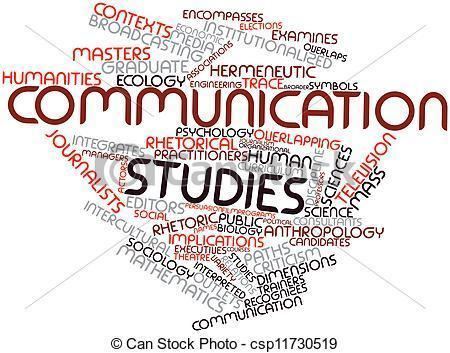
Communication studies is an academic field that deals with processes of human communication, commonly defined as the sharing of symbols to create meaning. The discipline encompasses a range of topics, from face-to-face conversation to mass media outlets such as television broadcasting. Communication studies also examines how messages are interpreted through the political, cultural, economic, semiotic, hermeneutic, and social dimensions of their contexts.
Scope
Communication studies integrates aspects of both social sciences and the humanities. Much of the work being done in the field is academic in nature. As a social science, the discipline often overlaps with sociology, psychology, anthropology, biology,[citation needed] political science, economics, and public policy, among others. From a humanities perspective, communication is concerned with rhetoric and persuasion (traditional graduate programs in communication studies trace their history to the rhetoricians of Ancient Greece).
A focus on research development sets communication studies apart from general communication degrees. Many of the students that chose the field do so in order to pursue doctoral level ambitions. Requirements for undergraduate degrees focus on preparing students to ask questions concerning the nature of communication in society and the development of communication as a specific field. University of Southern California, University of Pennsylvania, University of Kansas and Temple University have led the way,[according to whom?] offering undergraduate and graduate degrees that prepare students to ask critical questions in this research driven context.[citation needed]
In the United States, the National Communication Association (NCA) recognizes nine distinct but often overlapping sub-disciplines within the broader communication discipline: technology, critical-cultural, health, intercultural, interpersonal-small group, mass communication, organizational, political, rhetorical, and environmental communication. Students take courses in these subject areas. Other programs and courses often integrated in communication programs include journalism, film criticism, theatre, public relations, political science (e.g., political campaign strategies, public speaking, effects of media on elections), as well as radio, television and film production. More recently, computer-mediated communication and the implications of new media for communication have drawn new research and courses.
Flexibility
Part of what makes communication studies popular is its reputation for being flexible.Graduates of formal communication programs take many different career paths, including university professors, marketing researchers, media editors and designers, journalists, advertising executives, actors, human resources managers, corporate trainers, public relations practitioners, and media managers and consultants.