
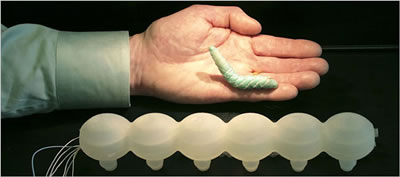
Robotics have been a major aspect of the 21st century in more ways than one, and will soon be taking up even larger roles as they become more sophisticated and, for some, when their cords are finally severed.
For soft robotics, however, the latter has been their latest development – the untethering of soft robots, taking their first steps without human assistance.
This major development in robotics is the result of hard work by developers from Harvard’s School of Engineering and Applied Sciences and the Wyss Institute for Biologically Inspired Engineering. The quadruped – the first ever untethered soft robot – not only severed its cords, but also has the ability to be engulfed in flames and come out of it unscathed. With the subsequent abilities to crawl through snow and be run over by a car, these super strengths were developed for a reason – future disaster relief scenarios.

Bio-inspired robotic locomotion is a fairly new sub-category of bio-inspired design. It is about learning from nature and applying it to the real world engineering systems.
More specifically, this field is about making robots that are inspired by the biological systems.
Biomimicry and bio-inspired design sometimes get mixed up. Biomimicry is copying the nature while bio-inspired design is learning from nature and making a mechanism that is simpler and more effective than the system observed in nature. Biomimicry has led to the development of a different branch of robotics called soft robotics.
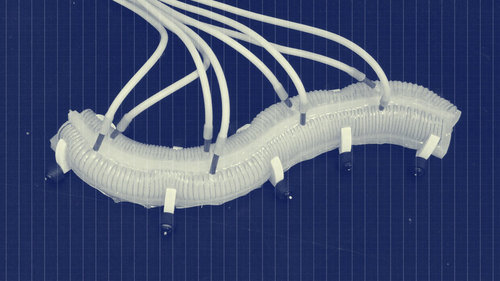
The biological systems have been optimized for specific tasks according to their habitat. However, they are multi-functional and are not designed for only one specific functionality. Bio-inspired robotics is about studying biological systems, and look for the mechanisms that may solve a problem in the engineering field. The designer should then try to simplify and enhance that mechanism for the specific task of interest. Bio-inspired roboticists are usually interested in biosensors (e.g. eye), bioactuators (e.g. muscle), or biomaterials (e.g. spider silk). Most of the robots have some type of locomotion system
Imagine seeing robotics with soft, flexible exteriors coursing through danger zones without any difficulty, potentially saving everyone’s life in the process. This is the prospect of untethered soft robotics in which researchers are hoping to engineer in the not-too-distant future. For the quadruped, there’s still much to do before it ever becomes society’s hero, but the potential is there and ready to be engineered and programmed. It’s only a matter of time now.