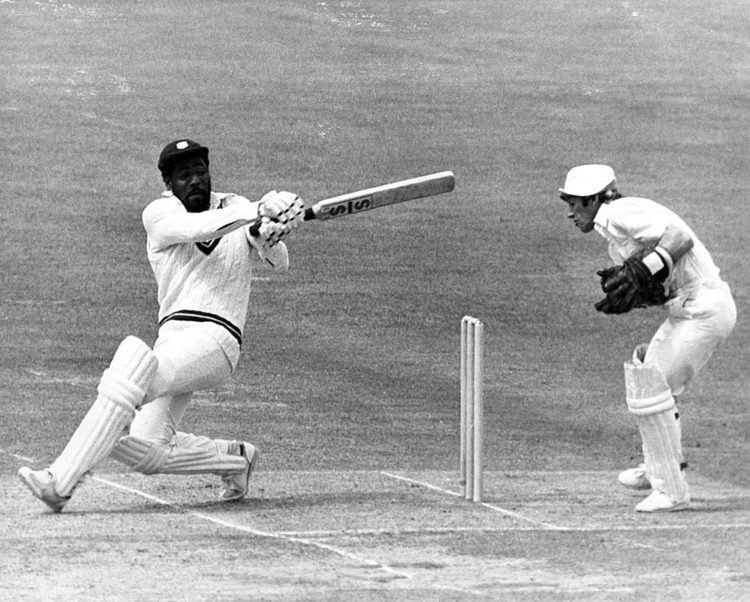
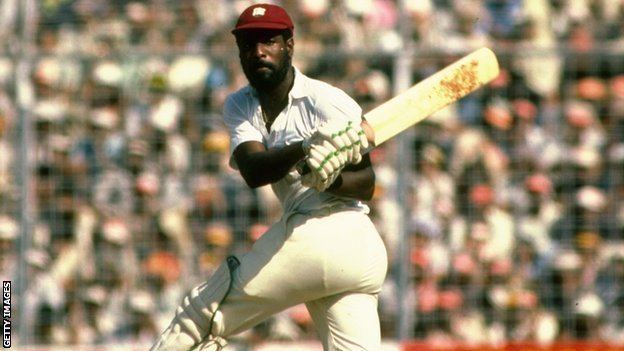
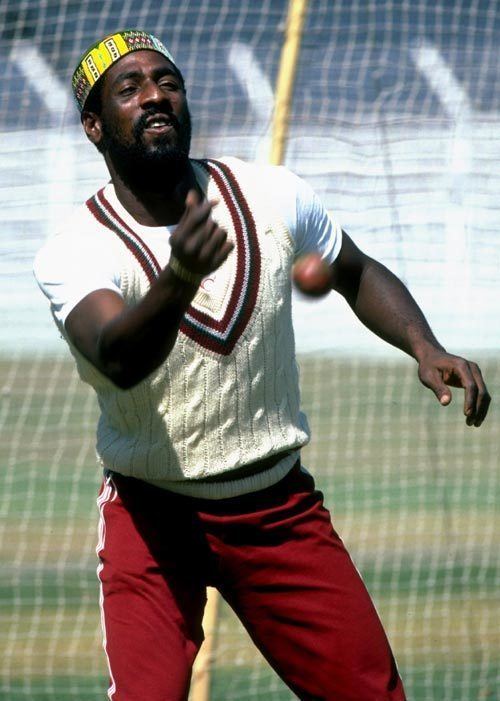
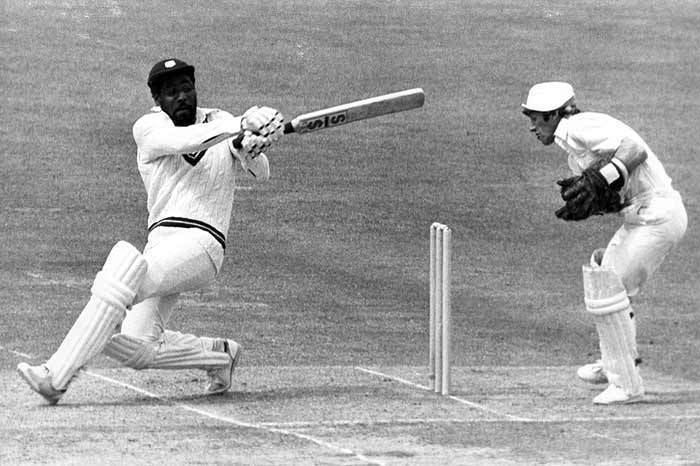
Sir Isaac Vivian Alexander Richards, KNH, OBE (born 7 March 1952), is a former West Indian cricketer. Popularly known as Viv (or King Viv), he is regarded as one of the greatest batsmen of all time and as one of the very finest players in the history of the sport. Richards was voted one of the five Cricketers of the Century in 2000, by a 100-member panel of experts, along with Sir Donald Bradman, Sir Garfield Sobers, Sir Jack Hobbs and Shane Warne. In February 2002, Richards was judged by Wisden Cricketers Almanack to have played the best ODI innings of all time. In December 2002, he was chosen by Wisden as the greatest One Day International (ODI) batsman of all time, as well as the third greatest Test batsman of all time, after Sir Don Bradman and Sachin Tendulkar.
Vivian Richards was born to Malcolm and Gretel Richards in St. Johns, Antigua, then part of the British Leeward Islands. He attended St. Johns Boys School and then Antigua Grammar School on a scholarship. Richards received encouragement at Antigua Grammar from sports teacher, Mr Reginald Samuels as well as from Mr Loydston Jacobs, the headmaster; both considered that he had promise. Richards initially trained with his father and Pat Evanson, a neighbour and family friend, who had captained the Antigua cricket side. He received further encouragement from his brothers, Mervyn and Donald, both of whom played for Antigua.
Richards left school at eighteen securing employment at DArcys Bar and Restaurant in St. Johns as well as joining St.Johns Cricket Club. The owner of the restaurant, DArcy Williams, provided Richards with new whites, gloves, pads and bat. After a few seasons with St.Johns C.C he joined the Rising Sun C.C where he would remain until his departure to play abroad. At the age of 22, after having played matches in the Antigua, Leeward Islands and Combined Islands tournaments, he was scouted by Len Creed, Vice Chairman at Somerset C.C., who was in Antigua at the time as part of a West Country touring side.
Richards relocated to the United Kingdom where Len Creed arranged for him to play League cricket for Lansdown C.C. in Bath. He made his Lansdown debut, as part of the second XI, at Weston-super-Mare on 26 April 1973. Richards was also employed by the club as assistant groundsman to head groundsman, John Heyward, to allow him some financial independence until his career was established. After his debut he was promoted to the first team where he was introduced to the Lansdown all-rounder "Shandy" Perera from Ceylon (now Sri Lanka). Richards cites Perera as a major influence on his cricket development especially with regards to post-game analysis. He finished his first season at Lansdown with top batting averages and shortly afterwards was offered a two year contract with county side Somerset.
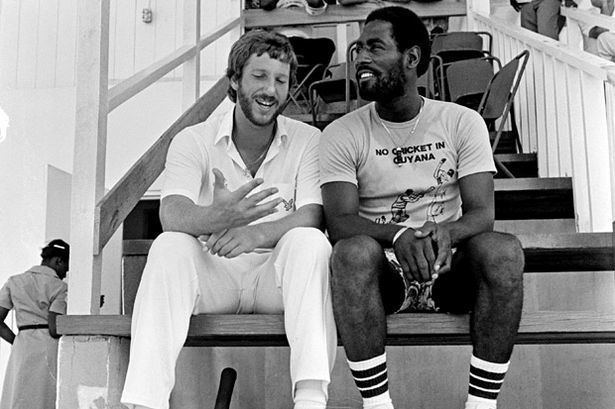
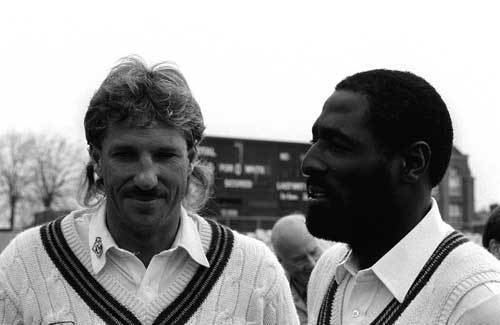
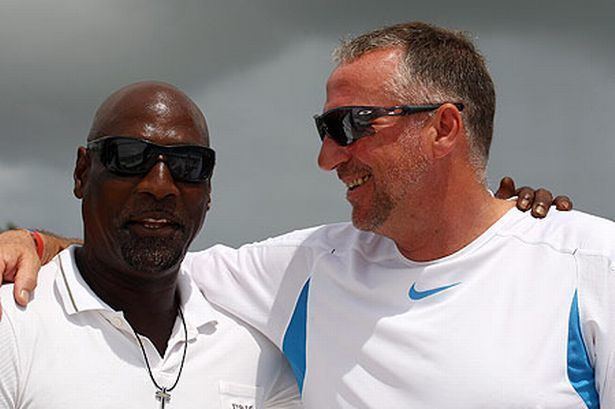
Fig : Sir Viv Richards and Sir Ian Botham
Richards then moved to Taunton in 1974 in preparation for his professional debut with Somerset CCC where he was assigned living accommodation by the club; a flat-share with two other county players: Ian Botham and Dennis Breakwell. On 27 April 1974 Richards made his County Championship debut for Somerset against Glamorgan in Swansea; after the game Somerset skipper Brian Close arranged a players ovation for Richards in recognition of his playing and contribution to the victory. Richards was awarded Man of the Match.
International career
Richards made his Test match debut for the West Indian cricket team in 1974 against India in Bangalore. He made an unbeaten 192 in the second Test of the same series in New Delhi. The West Indies saw him as a strong opener and he kept his profile up in the early years of his promising career.
In his Test career, he scored 8,540 runs in 121 Test matches at an average of 50.23 (including 24 centuries). Richards also scored 5 centuries in World Series Cricket between 1977–79. These are not recognised by the ICC as "official" Test centuries, but the high standard of cricket played in this series means that they can arguably be ranked alongside his 24 Test centuries. Richards won 27 of 50 matches as a Test captain, and lost only 8. He is also the scorer of the fastest-ever Test century, from just 56 balls against England in Antigua during the 1986 tour. He hit 84 sixes in Test cricket. His highest innings of 291 is sixth on the list of West Indies highest individual scores.
In 1975 Richards helped the West Indies to win the inaugural Cricket World Cup final, a feat he later described as the most memorable of his career. He starred in the field, running out Alan Turner, Ian Chappell and Greg Chappell. The West Indies were again able to win the following World Cup in 1979, thanks to a Richards century in the final at Lords, and Richards believes that on both occasions, despite internal island divisions, the Caribbean came together. He was until 2005 the only man to score a century and take 5 wickets in the same one-day international, against New Zealand at Dunedin in 1986–87. He rescued his side from a perilous position at Old Trafford in 1984 and, in partnership with Michael Holding, smashed 189 to win the game off his own bat.
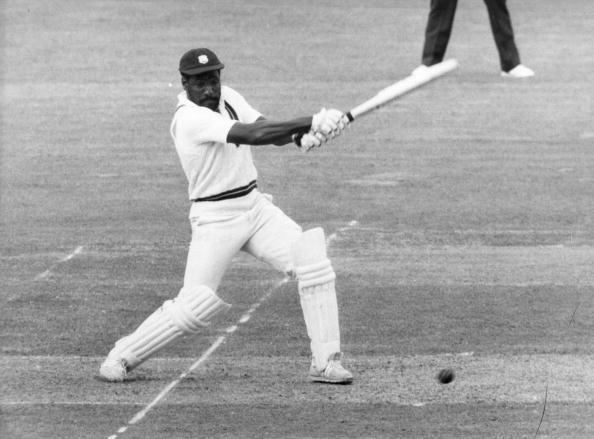
Vivian Richards,103 vs Australia 1985
1976 was perhaps Richards finest year: he scored 1710 runs, at an astonishing average of 90.00, with seven centuries in 11 Tests. This achievement is all the more remarkable considering he missed the second Test at Lords after contracting glandular fever; yet he returned to score his career-best 291 at the Oval later in the summer. This tally stood as the world record for most Test runs by a batsman in a single calendar year for 30 years until broken by Mohammad Yousuf of Pakistan on 30 November 2006.
Richards captained the West Indies in 50 Test matches from 1984 to 1991. He is the only West Indies captain never to lose a Test series, and it is said that his fierce will to win contributed to this achievement. His captaincy was, however, not without controversy: one incident was his aggressive, "finger-flapping" appeal leading to the incorrect dismissal of England batsman Rob Bailey in the Barbados Test in 1990, which was described by Wisden as "at best undignified and unsightly. At worst, it was calculated gamesmanship". This behaviour would nowadays be penalised according to Section 2.5. of the Rules of Conduct of the ICC Code of Conduct.
VivRichards vs AUS
During a match against Zimbabwe during the 1983 Cricket World Cup, Richards returned to the crease after a stoppage for bad light and accidentally took strike at the wrong end, which remains a very rare occurrence
Honours
In 1994, Richards was appointed an Officer of the Order of the British Empire (OBE) for services to cricket. In 1999, he was made a Knight of the Order of the National Hero (KNH) by his native country Antigua and Barbuda.
The Sir Vivian Richards Stadium in North Sound, Antigua, is named in his honour. It was built for use in the 2007 Cricket World Cup.
Sir Viv Richards guard of honour in his FINAL TESTINNINGS - 60 vs England 1991
Gallery
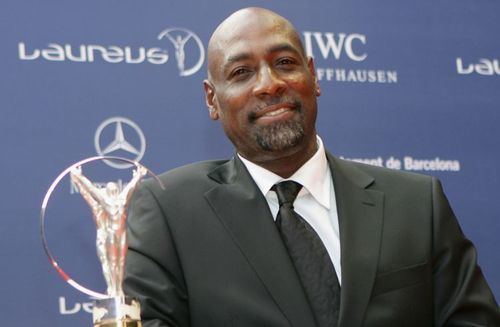
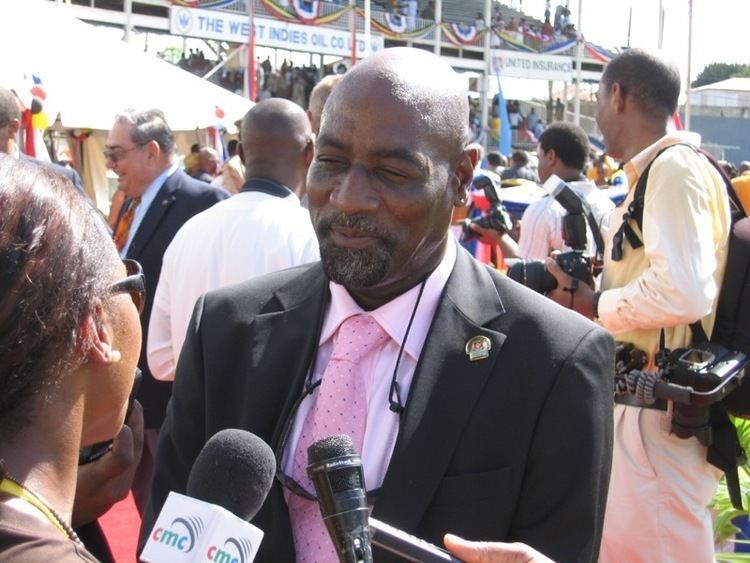
Fig : Richards being interviewed after a cricket match in 2006
.jpg)