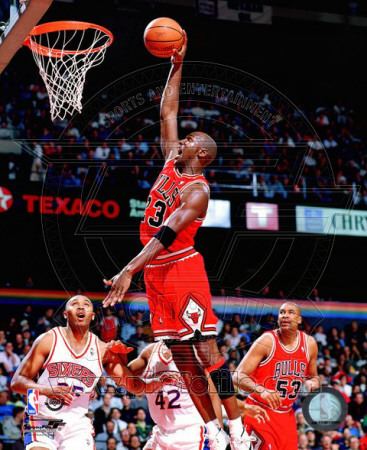
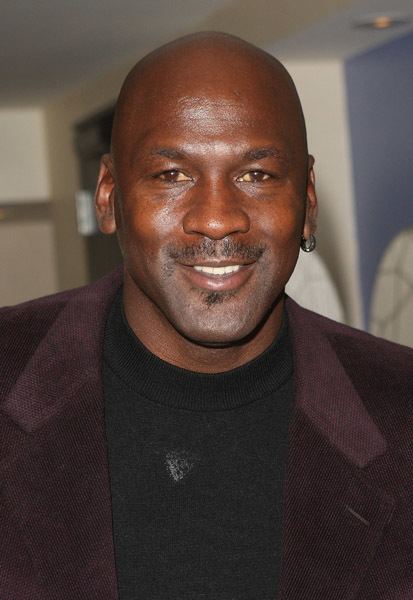
Michael Jeffrey Jordan (born February 17, 1963), also known by his initials, MJ, is an American former professional basketball player, entrepreneur, and principal owner and chairman of the Charlotte Hornets. He played 15 seasons in the National Basketball Association (NBA) for the Chicago Bulls and Washington Wizards. His biography on the NBA website states, "By acclamation, Michael Jordan is the greatest basketball player of all time." Jordan was one of the most effectively marketed athletes of his generation and was considered instrumental in popularizing the NBA around the world in the 1980s and 1990s.
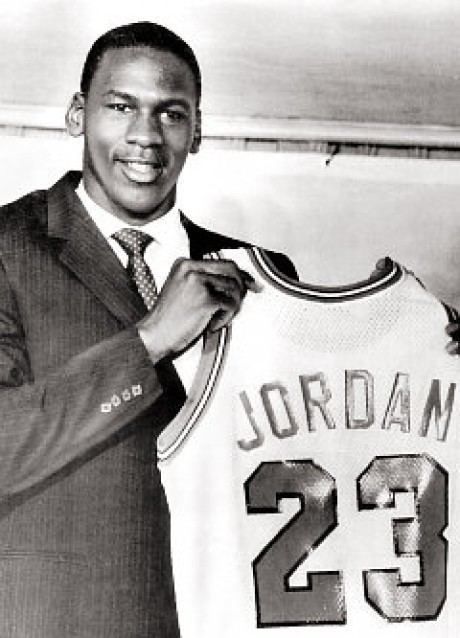
After a three-season career at the University of North Carolina at Chapel Hill, where he was a member of the Tar Heels national championship team in 1982, Jordan joined the NBAs Chicago Bulls in 1984. He quickly emerged as a league star, entertaining crowds with his prolific scoring. His leaping ability, illustrated by performing slam dunks from the free throw line in slam dunk contests, earned him the nicknames "Air Jordan" and "His Airness". He also gained a reputation for being one of the best defensive players in basketball. In 1991, he won his first NBA championship with the Bulls, and followed that achievement with titles in 1992 and 1993, securing a "three-peat". Although Jordan abruptly retired from basketball before the beginning of the 1993–94 NBA season to pursue a career in baseball, he rejoined the Bulls in 1995 and led them to three additional championships in 1996, 1997, and 1998, as well as an NBA-record 72 regular-season wins in the 1995–96 NBA season. Jordan retired for a second time in 1999, but returned for two more NBA seasons from 2001 to 2003 as a member of the Wizards.
Jordans individual accolades and accomplishments include five Most Valuable Player (MVP) Awards, ten All-NBA First Team designations, nine All-Defensive First Team honors, fourteen NBA All-Star Game appearances, three All-Star Game MVP Awards, ten scoring titles, three steals titles, six NBA Finals MVP Awards, and the 1988 NBA Defensive Player of the Year Award. Among his numerous accomplishments, Jordan holds the NBA records for highest career regular season scoring average (30.12 points per game) and highest career playoff scoring average (33.45 points per game). In 1999, he was named the greatest North American athlete of the 20th century by ESPN, and was second to Babe Ruth on the Associated Presss list of athletes of the century. He is a two-time inductee into the Basketball Hall of Fame – in 2009 for his individual career, and in 2010 as a member of the 1992 United States mens Olympic basketball team ("The Dream Team").
Jordan is also known for his product endorsements. He fueled the success of Nikes Air Jordan sneakers, which were introduced in 1985 and remain popular today. Jordan also starred in the 1996 feature film Space Jam as himself. In 2006, he became part-owner and head of basketball operations for the then-Charlotte Bobcats, buying controlling interest in 2010.
Jordan was born in Brooklyn, New York, the son of Deloris (née Peoples), who worked in banking, and James R. Jordan, Sr., an equipment supervisor. His family moved to Wilmington, North Carolina, when he was a toddler.
Jordan is the fourth of five children. He has two older brothers, Larry Jordan and James R. Jordan, Jr., one older sister, Deloris, and a younger sister, Roslyn. Jordans brother James retired in 2006 as the Command Sergeant Major of the 35th Signal Brigade of the XVIII Airborne Corps in the U.S. Army.
Professional career
Early NBA years (1984–1987)
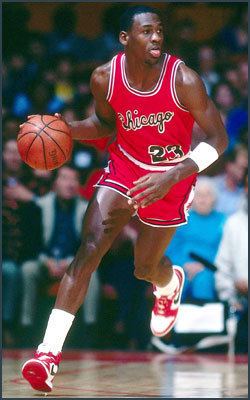
During his first season in the NBA, Jordan averaged 28.2 ppg on 51.5% shooting. He quickly became a fan favorite even in opposing arenas,and appeared on the cover of Sports Illustrated with the heading "A Star Is Born" just over a month into his professional career. Jordan was also voted in as an All-Star starter by the fans in his rookie season. Controversy arose before the All-Star game when word surfaced that several veteran players, led by Isiah Thomas, were upset by the amount of attention Jordan was receiving. This led to a so-called "freeze-out" on Jordan, where players refused to pass him the ball throughout the game. The controversy left Jordan relatively unaffected when he returned to regular season play, and he would go on to be voted Rookie of the Year. The Bulls finished the season 38–44, and lost in the first round of the playoffs in four games to the Milwaukee Bucks.
Jordans second season was cut short by a broken foot in the third game of the season, which caused him to miss 64 games. Despite Jordans injury and a 30–52 record (at the time it was fifth worst record of any team to qualify for the playoffs in NBA history),the Bulls made the playoffs. Jordan recovered in time to participate in the playoffs and performed well upon his return. Against a 1985–86 Boston Celtics team that is often considered one of the greatest in NBA history, Jordan set the still-unbroken record for points in a playoff game with 63 in Game 2. The Celtics, however, managed to sweep the series.
Jordan had recovered completely by the 1986–87 season, and had one of the most prolific scoring seasons in NBA history. He became the only player other than Wilt Chamberlain to score 3,000 points in a season, averaging a league high 37.1 points on 48.2% shooting. In addition, Jordan demonstrated his defensive prowess, as he became the first player in NBA history to record 200 steals and 100 blocks in a season. Despite Jordans success, Magic Johnson won the leagues Most Valuable Player Award. The Bulls reached 40 wins, and advanced to the playoffs for the third consecutive year. However, they were again swept by the Celtics.
First three-peat (1991–1993)
In the 1990–91 season, Jordan won his second MVP award after averaging 31.5 ppg on 53.9% shooting, 6.0 rpg, and 5.5 apg for the regular season. The Bulls finished in first place in their division for the first time in 16 years and set a franchise record with 61 wins in the regular season. With Scottie Pippen developing into an All-Star, the Bulls had elevated their play. The Bulls defeated the New York Knicks and the Philadelphia 76ers in the opening two rounds of the playoffs. They advanced to the Eastern Conference Finals where their rival, the Detroit Pistons, awaited them. However, this time the Bulls beat the Pistons in a surprising sweep. In an unusual ending to the fourth and final game, Isiah Thomas led his team off the court before the final seconds had concluded. Most of the Pistons went directly to their locker room instead of shaking hands with the Bulls.
The Bulls advanced to the NBA Finals for the first time in franchise history to face Magic Johnson and James Worthy and beat the Los Angeles Lakers four games to one, compiling an outstanding 15–2 playoff record along the way. Perhaps the best known moment of the series came in Game 2 when, attempting a dunk, Jordan avoided a potential Sam Perkins block by switching the ball from his right hand to his left in mid-air to lay the shot in. In his first Finals appearance, Jordan posted per game averages of 31.2 points on 56% shooting from the field, 11.4 assists, 6.6 rebounds, 2.8 steals and 1.4 blocks. Jordan won his first NBA Finals MVP award, and he cried while holding the NBA Finals trophy.
Jordan and the Bulls continued their dominance in the 1991–92 season, establishing a 67–15 record, topping their franchise record from 1990 to 91. Jordan won his second consecutive MVP award with averages of 30.1 points, 6.4 rebounds and 6.1 assists per game on 52% shooting. After winning a physical 7-game series over the New York Knicks in the second round of the playoffs and finishing off the Cleveland Cavaliers in the Conference Finals in 6 games, the Bulls met Clyde Drexler and the Portland Trail Blazers in the Finals. The media, hoping to recreate a Magic–Bird rivalry, highlighted the similarities between "Air" Jordan and Clyde "The Glide" during the pre-Finals hype. In the first game, Jordan scored a Finals-record 35 points in the first half, including a record-setting six three-point field goals. After the sixth three-pointer, he jogged down the court shrugging as he looked courtside. Marv Albert, who broadcast the game, later stated that it was as if Jordan was saying, "I cant believe Im doing this." The Bulls went on to win Game 1, and defeat the Blazers in six games. Jordan was named Finals MVP for the second year in a row and finished the series averaging 35.8 ppg, 4.8 rpg, and 6.5 apg, while shooting 53% from the floor.
In 1992–93, despite a 32.6 ppg, 6.7 rpg and 5.5 apg campaign, Jordans streak of consecutive MVP seasons ended as he lost the award to his friend Charles Barkley. Coincidentally, Jordan and the Bulls met Barkley and his Phoenix Suns in the 1993 NBA Finals. The Bulls captured their third consecutive NBA championship on a game-winning shot by John Paxson and a last-second block by Horace Grant, but Jordan was once again Chicagos catalyst. He averaged a Finals-record 41.0 ppg during the six-game series, and became the first player in NBA history to win three straight Finals MVP awards. He scored more than 30 points in every game of the series, including 40 or more points in 4 consecutive games. With his third Finals triumph, Jordan capped off a seven-year run where he attained seven scoring titles and three championships, but there were signs that Jordan was tiring of his massive celebrity and all of the non-basketball hassles in his life.
Jordan played on two Olympic gold medal-winning American basketball teams. As a college player he participated, and won the gold, in the 1984 Summer Olympics. The team was coached by Bob Knight and featured players such as Patrick Ewing, Sam Perkins, Chris Mullin, Steve Alford, and Wayman Tisdale. Jordan led the team in scoring, averaging 17.1 ppg for the tournament.
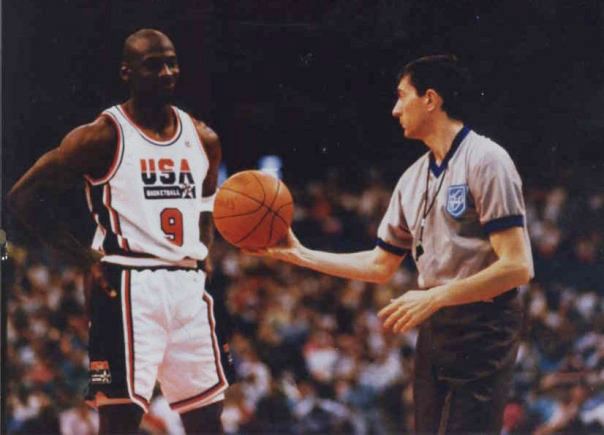
In the 1992 Summer Olympics, he was a member of the star-studded squad that included Magic Johnson, Larry Bird, and David Robinson and was dubbed the "Dream Team". Jordan was the only player to start all 8 games in the Olympics. Playing limited minutes due to the frequent blowouts, Jordan averaged 14.9 ppg, finishing second on the team in scoring. Jordan and fellow Dream Team members Patrick Ewing and Chris Mullin are the only American mens basketball players to win Olympic gold as amateurs and professionals.
Player profile
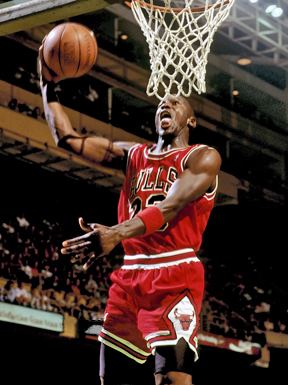
Fig : Jordan goes to the basket for a score in 1997.
Jordan was a shooting guard who was also capable of playing as a small forward (the position he would primarily play during his second return to professional basketball with the Washington Wizards), and as a point guard. Jordan was known throughout his career for being a strong clutch performer. With the Bulls, he decided 25 games with field goals or free throws in the last 30 seconds, including two NBA Finals games and five other playoff contests. His competitiveness was visible in his prolific trash-talk and well-known work ethic. Noted as a durable player, Jordan did not miss four or more games while active for a full season from 1986–87 to 2001–02, when he injured his right knee. He played all 82 games nine times. Jordan has frequently cited David Thompson, Walter Davis, and Jerry West as influences. From the start of his career, Jordan was unique among NBA players in that he had a special "Love of the Game Clause" written into his contract, which allowed him to play basketball against anyone at anytime, anywhere.
Jordan had a versatile offensive game. He was capable of aggressively driving to the basket, as well as drawing fouls from his opponents at a high rate; his 8,772 free throw attempts are the ninth-highest total of all time. As his career progressed, Jordan also developed the ability to post up his opponents and score with his trademark fadeaway jump shot, using his leaping ability to "fade away" from block attempts. According to Hubie Brown, this move alone made him nearly unstoppable. Despite media criticism as a "selfish" player early in his career, Jordans 5.3 assists per game also indicate his willingness to defer to his teammates. In later years, the NBA shortened its three-point line to 22 feet (from 23 feet, 9 inches), which coupled with Jordans extended shooting range to make him a long-range threat as well—his 3-point stroke developed from a low 9/52 rate (.173) in his rookie year into a stellar 111/260 (.427) shooter in the 1995–96 season.For a guard, Jordan was also a good rebounder (6.2 per game).
Michael Jordan Career Highlights (Hall of Fame 2009)
In 1988, Jordan was honored with the NBAs Defensive Player of the Year Award and became the first NBA player to win both the Defensive Player of the Year and MVP awards in a career (since equaled by Hakeem Olajuwon, David Robinson, and Kevin Garnett; Olajuwon is the only player other than Jordan to win both during the same season). In addition he set both seasonal and career records for blocked shots by a guard, and combined this with his ball-thieving ability to become a standout defensive player. He ranks third in NBA history in total steals with 2,514, trailing John Stockton and Jason Kidd. Jerry West often stated that he was more impressed with Jordans defensive contributions than his offensive ones.
Honors and awards
Jordan won numerous awards and set many records during his career. The following are some of his achievements:
•Naismith Memorial Basketball Hall of Fame Class of 2009 (individual), Class of 2010 (member of the "Dream Team")
•2 Olympic gold medals – 1984, 1992
•6× NBA champion
•6× NBA Finals MVP
•5× NBA MVP
•10 NBA scoring leader (1987–1993, 1996–1998)
•3× steals leader (1988, 1990, 1993)
•3× minutes leader
•14 NBA All-Star selections
•3× NBA All-Star Game MVP
•11 All-NBA selections
•9 All-Defensive First Team selections
•2× NBA Slam Dunk Contest champion – 1987, 1988
•NBA Rookie of the Year – 1984–85
•NBA Defensive Player of the Year – 1987–88
•NCAA national championship – University of North Carolina at Chapel Hill: 1981–82
•ACC Freshman of the Year – 1981–82
•2× Consensus NCAA All-American First Team – 1982–83, 1983–84
•ACC Mens Basketball Player of the Year – 1983–84
•USBWA College Player of the Year – 1983–84
•Naismith College Player of the Year – 1983–84
•John R. Wooden Award – 1983–84
•Adolph Rupp Trophy – 1983–84
•Sports Illustrated Sportsman of the Year – 1991
•Named one of the 50 Greatest Players in NBA History in 1996
•Ranked No.1 by SLAM Magazines Top 50 Players of All-Time[200]
•Ranked No.1 by ESPN SportsCenturys Top North American Athletes of the 20th century[142]
•Elected to North Carolina Sports Hall of Fame
•Marca Leyenda
Fig : James Worthy, Jordan, and Dean Smith at a University of North Carolina game honoring the 1957 and 1982 mens basketball teams
.jpg)
![[37931615.jpg]](https://alchetron.com/cdn/professional-basketball-player-michael-jordan-af4ede88-8a4f-4de7-8b46-d946e74fb89-resize-750.jpeg)