
Hot Spot Technology
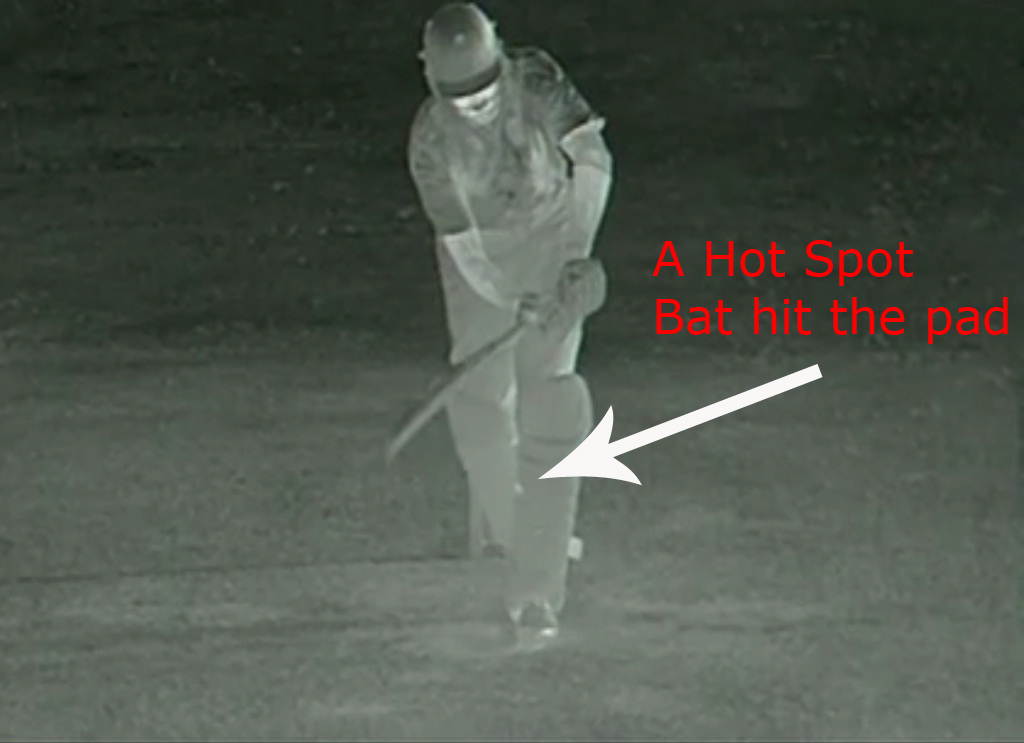
Hot Spot is an infra-red imaging system used in to determine whether the ball has struck the batsman, bat or pad. Hot Spot requires two infra-red cameras on opposite sides of the ground above the field of play that are continuously recording an image. Any suspected snick or bat/pad event can be verified by examining the infrared image, which usually shows a bright spot where contact friction from the ball has elevated the local temperature. Where referrals to an off-field third umpire are permitted, the technology is used to enhance the on-field umpires decision-making accuracy. Where referrals are not permitted, the technology is used primarily as an analysis aid for televised coverage.
History
Hot Spot uses technology developed in the military for tank and jet fighter tracking.The technology was founded by French scientist Nicholas Bion, before being worked upon by many companies in Paris and being bought and adopted by the Australian Nine Network.The technology was adapted for television by BBG Sports, the Australian company responsible for the Snickometer, in conjunction with Sky Sports.The technology was first used during the first Test match of the 2006-07 Ashes at The Gabba, on 23 November 2006.
The ICC announced that Hot Spot images would be available for use as part of its ongoing technology trial during the second and third Tests (March 2009) in South Africa. The system was to be available to the third umpire in the event of a player referral.
For the 2012 season BBG Sport introduced a new generation of HOT Spot using the very high performance SLX-Hawk thermal imaging cameras provided by UK based SELEX Galileo. These cameras provided sharper images with improved sensitivity and much less motion blur than earlier HOT Spot technologies.As a result, the latest HOT Spot system is able to detect much finer edge nicks than in previous seasons, essentially ending all earlier doubts about the capability of the technology. Following the success of this updated HOT Spot system, BBG Sport and SELEX Galileo signed an exclusivity agreement for the supply of SLX-Hawk cameras for HOT Spot in cricket and other sports.

Hot Spot has two main advantages over its competing technology, the Snickometer, which is a sound-detection based system. Snickometer often produces inconclusive results indicating contact (potentially any combination of bat, pad and ball) only, whereas the Hot Spot clearly shows exactly what the ball strikes. Precise synchronisation of the Snickometer sound with associated pictures takes time, making it currently not suitable for use in the umpire decision review system.
Hot Spot technology, even though claimed to be extremely accurate, is not used in many matches.[citation needed] The main reason for this is its expense: $6000 per day for the use of two cameras and $10000 for the use of four cameras.Warren Brennan, the owner of BBG Sports, said the unwillingness of the International Cricket Council or national cricket boards to pay to use the expensive technology had restricted its use: "We wont be supplying Hot Spot to the World Cup next year, even for the semis or finals, if the cricket boards want a feed of that for adjudication purposes, they should contribute to the costs. The Ashes could be the last hurrah."
In the India-England ODI Series in 2011, there were controversial decisions based on the Hot Spot technology going against Indias Rahul Dravid on more than one occasion where Hot Spot replays proved inconclusive and yet Dravid was given out. On one occasion, there seemed to be a nick which Hot Spot wasnt able to detect. These incidents threw the role of Hot Spot technology into doubt once again.
In the 2013 Ashes, many decisions again cast doubts on Hotspot Technology.
1. Hawk-Eye
2. Umpire Decision Review System
Hot Spot Technology is used at many places Information Available on links given below
Hot Spot is an infra-red imaging system used in to determine whether the ball has struck the batsman, bat or pad. Hot Spot requires two infra-red cameras on opposite sides of the ground above the field of play that are continuously recording an image. Any suspected snick or bat/pad event can be verified by examining the infrared image, which usually shows a bright spot where contact friction from the ball has elevated the local temperature. Where referrals to an off-field third umpire are permitted, the technology is used to enhance the on-field umpires decision-making accuracy. Where referrals are not permitted, the technology is used primarily as an analysis aid for televised coverage.
History
Hot Spot uses technology developed in the military for tank and jet fighter tracking.The technology was founded by French scientist Nicholas Bion, before being worked upon by many companies in Paris and being bought and adopted by the Australian Nine Network.The technology was adapted for television by BBG Sports, the Australian company responsible for the Snickometer, in conjunction with Sky Sports.The technology was first used during the first Test match of the 2006-07 Ashes at The Gabba, on 23 November 2006.
The ICC announced that Hot Spot images would be available for use as part of its ongoing technology trial during the second and third Tests (March 2009) in South Africa. The system was to be available to the third umpire in the event of a player referral.
For the 2012 season BBG Sport introduced a new generation of HOT Spot using the very high performance SLX-Hawk thermal imaging cameras provided by UK based SELEX Galileo. These cameras provided sharper images with improved sensitivity and much less motion blur than earlier HOT Spot technologies.As a result, the latest HOT Spot system is able to detect much finer edge nicks than in previous seasons, essentially ending all earlier doubts about the capability of the technology. Following the success of this updated HOT Spot system, BBG Sport and SELEX Galileo signed an exclusivity agreement for the supply of SLX-Hawk cameras for HOT Spot in cricket and other sports.
Hot Spot has two main advantages over its competing technology, the Snickometer, which is a sound-detection based system. Snickometer often produces inconclusive results indicating contact (potentially any combination of bat, pad and ball) only, whereas the Hot Spot clearly shows exactly what the ball strikes. Precise synchronisation of the Snickometer sound with associated pictures takes time, making it currently not suitable for use in the umpire decision review system.
Hot Spot technology, even though claimed to be extremely accurate, is not used in many matches.[citation needed] The main reason for this is its expense: $6000 per day for the use of two cameras and $10000 for the use of four cameras.Warren Brennan, the owner of BBG Sports, said the unwillingness of the International Cricket Council or national cricket boards to pay to use the expensive technology had restricted its use: "We wont be supplying Hot Spot to the World Cup next year, even for the semis or finals, if the cricket boards want a feed of that for adjudication purposes, they should contribute to the costs. The Ashes could be the last hurrah."
In the India-England ODI Series in 2011, there were controversial decisions based on the Hot Spot technology going against Indias Rahul Dravid on more than one occasion where Hot Spot replays proved inconclusive and yet Dravid was given out. On one occasion, there seemed to be a nick which Hot Spot wasnt able to detect. These incidents threw the role of Hot Spot technology into doubt once again.
In the 2013 Ashes, many decisions again cast doubts on Hotspot Technology.
1. Hawk-Eye
2. Umpire Decision Review System
Hot Spot Technology is used at many places Information Available on links given below