.jpg)
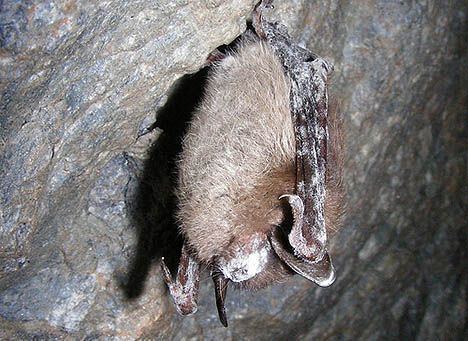
A cluster of little brown bats exhibiting the symptoms of White Nose Syndrome.
Somethings wrong in the bat cave. No, not Batman and Robins lair were talking actual bat caves full of thousands of bats. You see, when winter rolls around, bats join the bears, chipmunks and other furry mammals and tuck in tight for hibernation. Hibernation conserves energy during the season when food is scarce and the weather is harsh. The birds of the night take their winter sleep in caves called hibernaculums.
In the winter of 2006 in Albany, N.Y., something strange happened to hibernating bats during what should have been a dormant period. A wildlife biologist noticed that some bats were awake and flying outside of their hibernaculums during the day when they were supposed to be deep in slumber [source: USGS]. He also noticed a ring of white fungus around their noses, as though they had taken a whiff of flour. By early 2007, as many as 11,000 bats in New York caves had died [source: Metzner]. The ones examined by wildlife specialists appeared emaciated, with little to no fat left on their bodies and scarring on their wings.
Scientists have compared this bizarre bat plague to Colony Collapse Disorder, which has mysteriously wiped out thousands of honeybees [source: Bat Conservation International]. Bees affected by the disorder shared similar odd behavior with the bats, flying outside of their hives during cold weather and appearing physically altered when they died.
This crisis may not concern those who only associate bats with Dracula and haunted houses, but bats are actually more friend than foe to people. Dont like mosquito bites? Score a point for bats since these flying mammals devour up to 600 mosquitoes in one hour [source: Swartz Lab]. Around 70 percent of bats around the world exclusively eat insects, although some tropical species eat fruit and others eat small animals, like frogs and rodents [source: Swartz Lab].
White nose syndrome threatens North American bats #Video
Because of these dietary habits, a drop in the bat population would negatively impact people, especially farmers who benefit from the natural pest control bats perform.
What Is White Nose Syndrome?
A little brown bat (Myotis lucifigus) with the white fungus covering its muzzle and body.
Like a case of chickenpox in a kindergarten classroom, the bat pestilence moved fast after it first cropped up in Albany, N.Y. By spring 2008, evidence of bat deaths showed up in Massachusetts, Pennsylvania, Connecticut and Vermont, slicing the bat population in some hibernation caves from 15,000 to 1,500 [source: Hill]. The New York State Department of Environmental Conservation took the lead in 2007 to investigate what was decimating the bat population. They named the malady White Nose Syndrome (WNS), for the white fungus primarily found on infected bats noses, wings, ears and tails.
The research conducted by the New York State Department of Environmental Conservation showed that WNS had spread to almost every cave within an 80-mile (128-kilometer) radius from the infected ones discovered in 2007 [source: Hicks]. That translates to about half a million bats exposed to WNS [source: Hicks].
Infected bats likely spread the syndrome to nearby caves by coming into contact with healthy bats during warmer summer months.
Five bat species in particular have been struck by WNS: little brown myotis, Indiana myotis, northern myotis, eastern small-footed myotis and eastern pipistrelle [source: Bat Conservation International]. Scientists dont know how far or fast WNS could spread, but it could potentially reach Ohio and Virginia [source: Hicks]. With a mortality rate between 80 and 100 percent, the syndrome could seriously threaten the future of these affected bat species [source: U.S. Fish and Wildlife Service]. The Indiana myotis especially concerns wildlife specialists because its already federally classified as an endangered species. Its global population hovers around 550,000, but the Indiana myotis tends to cluster together in large numbers, which means an infected cave could cripple any chances of recovery [source: New York State Department of Environmental Conservation].
The U.S. Fish and Wildlife Service has stepped in as well to try to pinpoint whats causing the problem. According to Bat Conservation International, specialists suspect one of three scenarios:
• An unknown virus or pathogen
• Varying hibernation patterns due to climate change and warmer winters
• Decreased food supply due to man-made pesticides that kill insects, leaving bats without enough fat to make it through winter
But what about all that white fungus? Isnt that the culprit? Because the fungus isnt found uniformly on all bats, the fungus is likely a symptom rather than the root of the problem [source: U.S. Fish and Wildlife Service]. So far, researchers havent isolated a WNS pathogen or bacteria from the dead bats. The bats emaciation has led some to suspect that WNS is linked to some type of alteration in their metabolisms, although that hasnt been confirmed.
Teaming up with volunteers and researchers at colleges and universities, government officials are scrambling to solve this puzzle. Although no one has reported any human side effects of WNS, warnings have gone out to cavers in infected areas to take precautions like cleaning their clothes and shoes when they exit caves to ensure they dont spread WNS. Some caves have even been closed off for research.